The short answer
Use peak simultaneous demand as your starting point, then account for suitable rooms already available, where people work and the duration of each session. There is no single employee-to-booth ratio that proves the right quantity for every office.
Start with attendance, not total headcount
Record how many people actually attend on busy days and where they sit. A company headcount includes people who may be remote, travelling or based elsewhere. Using that number alone can obscure the needs of the team sharing one floor. Include visiting colleagues if they regularly need call space.
Talk to teams with different work patterns. Someone taking short unscheduled calls has a different requirement from a colleague with several booked video meetings. Record the problem each team reports: nowhere to speak, nowhere to concentrate, or nowhere for two people to meet. Those problems do not always need the same type of pod.
Measure the busy periods
Choose a representative week and make a simple observation sheet. At agreed intervals, record how many people need individual call space, how many small meetings are taking place and whether suitable rooms are already occupied. You do not need to record call contents or personal details to understand the pattern.
Pay attention to waiting and abandoned attempts as well as occupied rooms. A room booking calendar can look full because of unused reservations, while an informal phone booth may have no calendar at all. Combine observations with feedback and avoid treating one unusually quiet Friday as representative of the whole workplace.
- People present and the time of day.
- Simultaneous calls, seated focus sessions and small meetings.
- Suitable existing rooms genuinely available at that time.
- Queues, interruptions and spaces people avoid using.
A simple planning example
Imagine a team observes six simultaneous individual calls during a busy half-hour. Two suitable private rooms are reliably available for those calls. That leaves a shortfall of four individual spaces in this example. Four booths would cover that observed moment, but the subtraction is a starting point for discussion, not a procurement formula or a guarantee that nobody will wait.
Now ask whether those rooms stay available, whether calls overrun and whether people can reach the proposed booths easily. Check the pattern over several busy periods before choosing a quantity. If the same spaces are also expected to host lengthy focus sessions, calculate that demand separately rather than counting the spaces twice.
Choose the mix before finalising the number
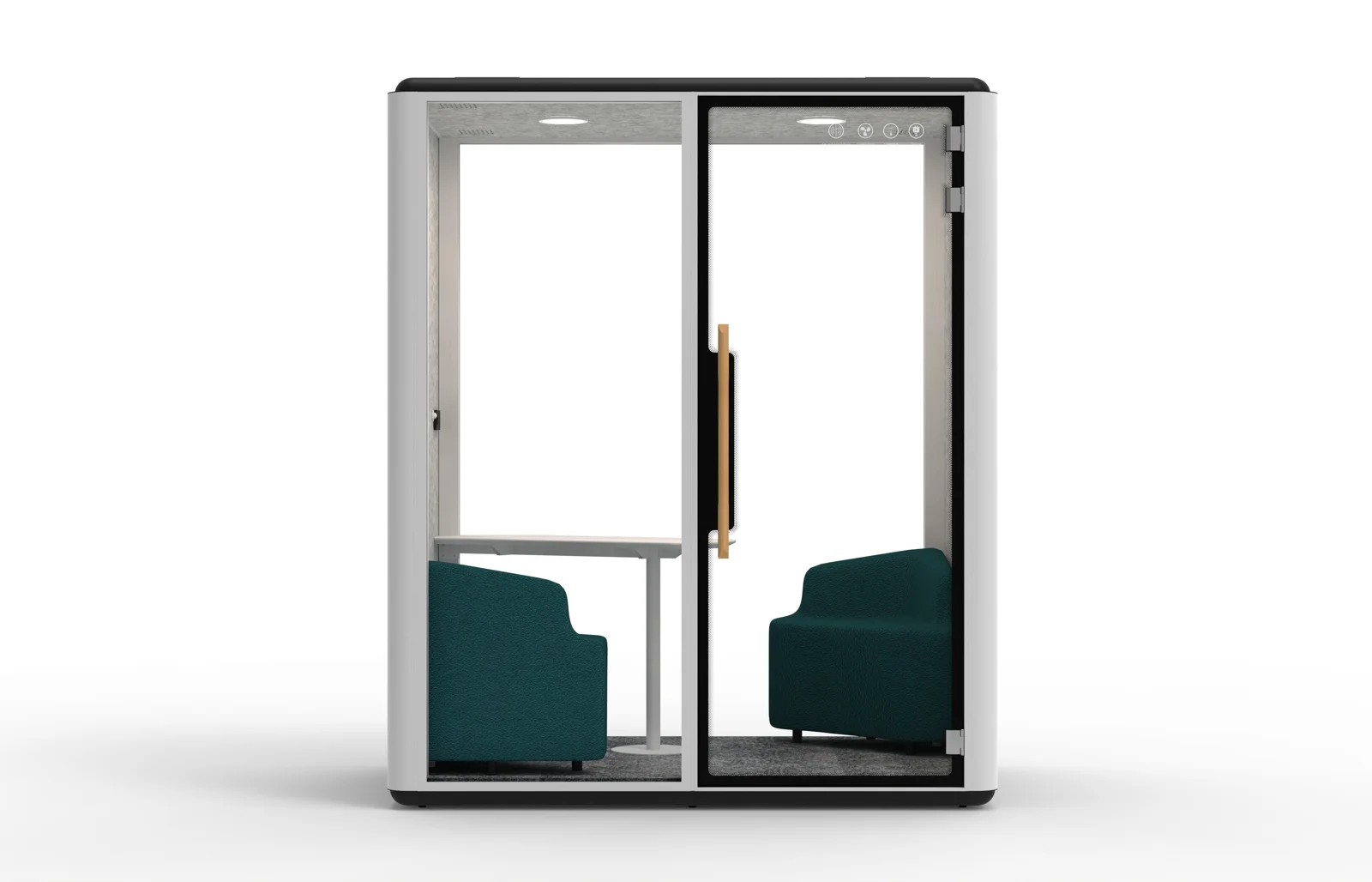
Short calls, concentrated desk work and face-to-face meetings compete for space if there is only one kind of pod. Separate the brief into phone booths, seated focus pods and meeting pods. A two-person meeting should not depend on squeezing into a product intended for one person.
Manufacturer ratios can be useful prompts, but their assumptions matter. Framery publishes recommendations by pod type and employee count in its FAQ. Treat those as guidance for its range, not a standard that automatically applies to a MEAVO, COMINE or FlexiSpot layout. Your attendance, existing rooms and observed demand still need to shape the shortlist.
Review the layout after people start using it
Position and shared-use rules can affect availability as much as quantity. Explain which spaces are for short calls, which can be booked and how a booking is released if no longer needed. Do not introduce a strict time limit without understanding whether it prevents the intended work.
After a representative period of use, revisit the same observations. If a booth stays empty, ask about location, comfort or equipment before assuming there is no demand. If a focus pod is always occupied by brief calls, reconsider the mix. Where the supplier supports a phased purchase, use this review to inform the next stage rather than ordering entirely from a headline ratio.
Written by Office Acoustics Ltd. General buying and planning guidance, not a substitute for model-specific instructions or a site assessment. Confirm current specifications and local availability before ordering.